
Payment and checkout forms touch some of the most sensitive fields in any application: bank account numbers, card numbers, and billing addresses. Testing them thoroughly without using real customer financial data takes a deliberate approach.
Why you should not use real financial data for testing
Using real IBANs, card numbers, or customer addresses in development, staging, or automated tests is a data-minimization risk under data-protection rules like GDPR, with no actual testing benefit — synthetic data that follows the same structural rules works just as well for validation logic.
Test data you need for a payment form test suite
A typical payment or checkout form combines several distinct fields, each with its own format rules to test against.
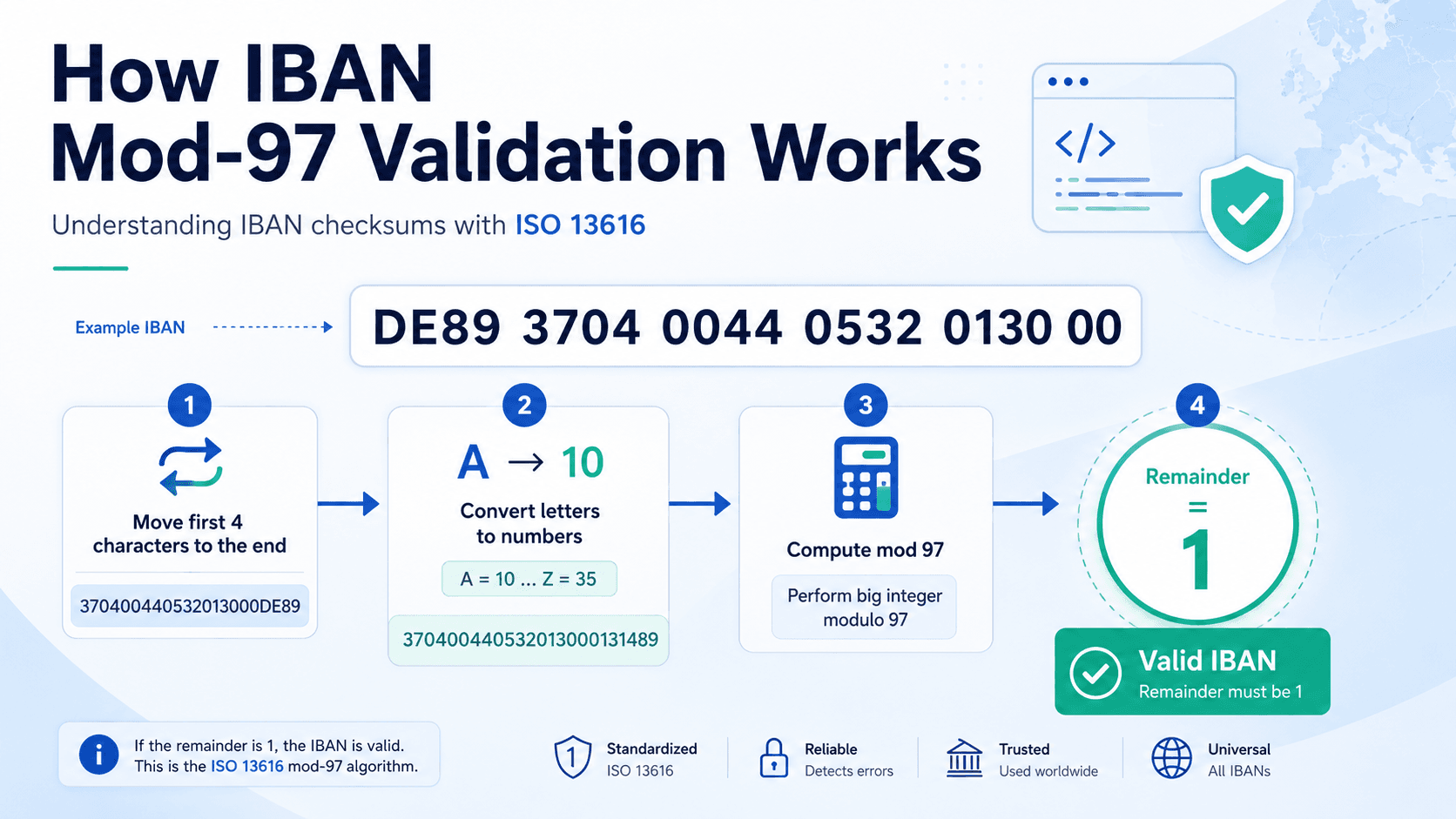
Bank account number — use Fake IBAN Generator for checksum-valid test IBANs across 36 countries
Card number — use Credit Card Validator to check brand detection, length, and Luhn checksum logic
Billing postal code — use Billing Postal Code Generator for US ZIP codes with matching city/state
Billing address — use Random Address Generator for US, Canada, UK, or Australia formatted addresses
Building a repeatable QA workflow
For negative-path testing, deliberately generate invalid data — a wrong-length IBAN, a broken checksum, an unsupported country code — to confirm your form and backend correctly reject bad input rather than silently accepting it.
For positive-path and load testing, batch-generate test data (for example, up to 500 IBANs at once) and export it as CSV, JSON, or TXT to seed a QA database or automated test fixtures.
Tools mentioned in this guide