

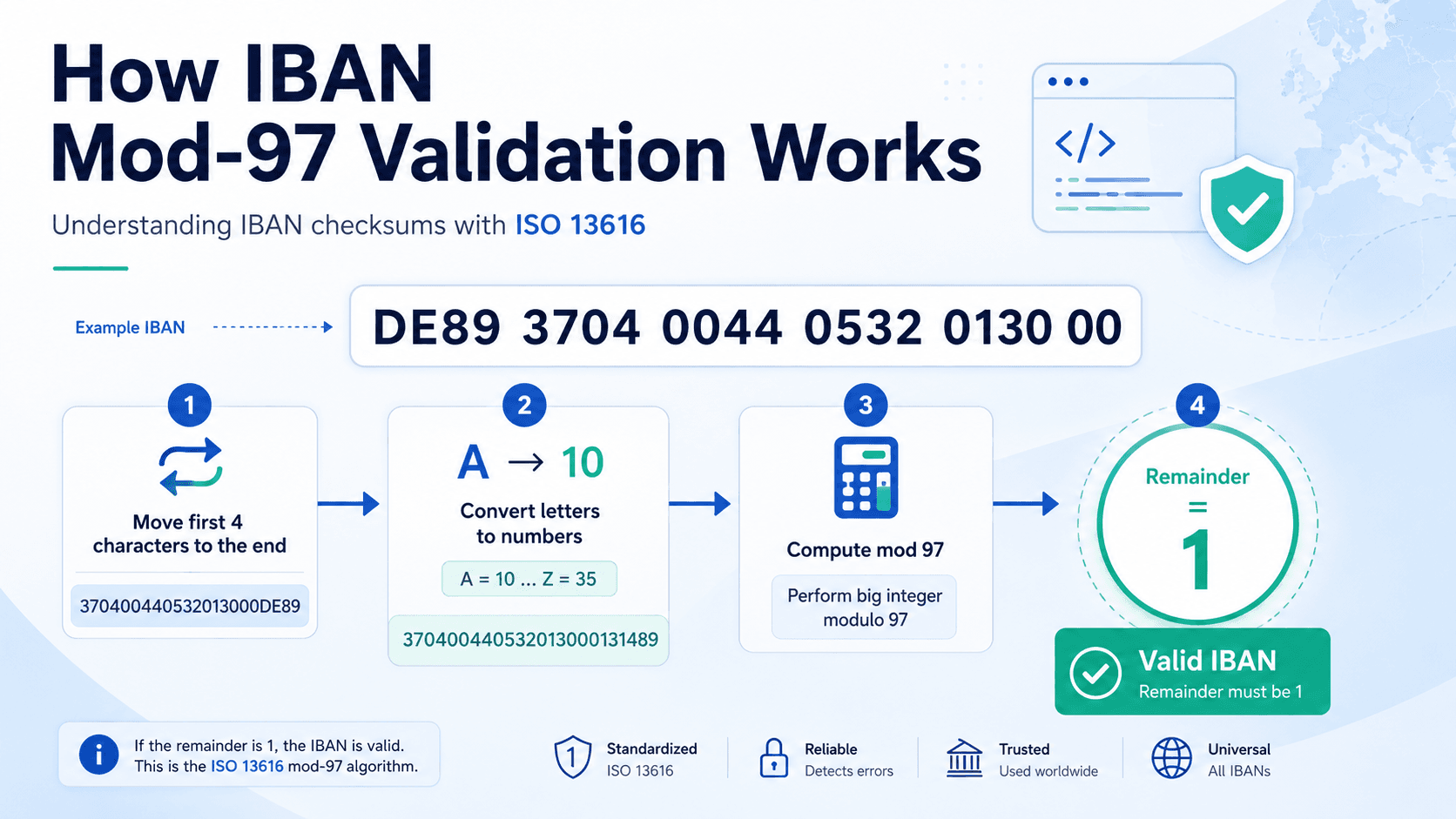
IBAN and SWIFT/BIC show up together on almost every international wire transfer form, which leads to a common question: aren't they the same thing? They are not — they identify two different things in the payment chain.
What IBAN identifies
An IBAN (International Bank Account Number) identifies a specific bank account — the country, the bank, and the account number, all in one structured, self-validating string.
What SWIFT/BIC identifies
A SWIFT/BIC code (Bank Identifier Code) identifies the bank institution itself, not an individual account. For example, DEUTDEDB identifies Deutsche Bank in Germany. It tells the payment network which bank to route money to.
When you need both
For international wire transfers, you typically need both: the IBAN to identify the receiving account, and the BIC to route the transfer to the correct bank.
For SEPA transfers within the EU/EEA, customers generally don't need to provide a BIC alongside the IBAN since 2016 — banks route the payment using directory lookups based on the IBAN's country code and bank identifier segment, rather than deriving the BIC algorithmically.
| IBAN | SWIFT/BIC --- | --- | --- Identifies | A specific bank account | A bank institution Length | Varies by country (15–34 chars) | 8 or 11 characters Required for SEPA? | Yes | No, since 2016 Required for international wire? | Yes | Usually yes
Tools mentioned in this guide